How ChatGPT, Gemini and Google's AI Answers Choose Local Businesses
Visitors ask ChatGPT, Gemini and Google's AI where to eat, and the companies say little about how a name gets picked. Here is what is documented, what is measured, what is unknown, and what you can do today.

Nobody outside OpenAI and Google can say exactly how an AI assistant picks the businesses it names. What exists is a few pages the companies publish, a set of vendor studies run mostly on US data, and a lot of confident guessing. This guide keeps the three apart, then shows what you control either way.
A late-night question in Hongdae
Take a made-up example. A traveler lands late and checks into a guesthouse in Hongdae. At 11 p.m. she opens ChatGPT and types: "Where can I get good food near me that's still open?"
OpenAI's help page describes what happens next. ChatGPT may estimate her general location, such as her country or city, from her IP address and rewrite "near me" into a place. OpenAI's own example turns "good restaurants near me" into a search for top restaurants in San Francisco. So the search that runs is probably about Seoul, not her street. That last step is our inference. Device location sharing, which gives ChatGPT more precise information about nearby businesses, is off by default, and a tired traveler probably hasn't turned it on.
ChatGPT then sends that search to its providers, reads what comes back, and writes a short list with links. OpenAI also says it may share location with trusted third-party providers of local information, such as nearby business listings. It does not name them. Why one place came back and another did not is the part no company publishes.
| Kind of knowledge | What we have | How far to trust it |
|---|---|---|
| Documented | Help pages and developer docs from Google and OpenAI, including Gemini's use of Google Maps data | Reliable for what they say. Silent on ranking. |
| Measured | Vendor studies of AI answers, none on Korean data | Patterns, not causes. Seoul untested. |
| Unknown | Most of where ChatGPT gets place data; how Grok or Siri pick places | Guesses only. |
What Google and OpenAI document
Google's page on AI features says there are no additional requirements to appear in AI Overviews or AI Mode, and no special optimizations. A page has to be indexed and eligible to show in Search with a snippet. You don't need new machine-readable files, AI text files or special schema, and indexing isn't guaranteed. Among its best practices, Google lists keeping your Business Profile information up to date. Its newer guide to generative AI features, updated July 10, 2026, says AI answers can include information about local businesses and that a Business Profile can help you show up in them. Our guide to what Google actually says about GEO, llms.txt and AI SEO covers the rest.
AI Mode has worked in Korean since September 8, 2025, when Google added it among five new languages. That helps with Korean customers. Most visitors likely ask in English or their own language, so the English pages and listings their questions pull in matter more to you than the Korean launch.
OpenAI
OpenAI's consumer help page documents the location rewrite above and says ChatGPT shares that general location, never the IP address itself, with third-party search providers. Among those providers' privacy policies it links Microsoft's. Its Enterprise and Edu page is plainer: searches from those workspaces may go to Bing, stripped of account details. Neither page lists the sources behind local answers or says how businesses are ranked.
OpenAI also runs OAI-SearchBot, the crawler that finds sites for ChatGPT search, and a separate training crawler, GPTBot. Our guide to letting the crawlers in shows how to check yours.
Gemini
Google's Gemini Apps Help says the Gemini app uses public Google Maps information to find places and give their addresses, ratings and opening hours. That makes Gemini the one assistant here with a documented tie to Google Maps data, and so to your Google profile. Some newer place features work only when you ask in English. For developers, Google offers a tool that grounds Gemini's answers in Google Maps data on more than 250 million places, with reviews, photos, addresses and hours. At launch, answers drawn from reviews covered only the US and India, and Google's docs still say the tool may not be available in all regions.
What these pages leave out matters as much. None says how a business is ranked, how many sources an answer draws on, or whether a Google profile counts for more than a website. They describe access, not weight. Anyone who tells you the weights is guessing or selling.
What vendor studies measure, mostly on US data
Companies that sell local-search software have studied AI answers, and two findings repeat. AI answers lean on business websites, Google profiles and review sites, which our guide to where a Seoul business should be listed for tourists goes through. And the same question can name different businesses from one run to the next, which is why we explain why AI recommendations change and how to measure them.
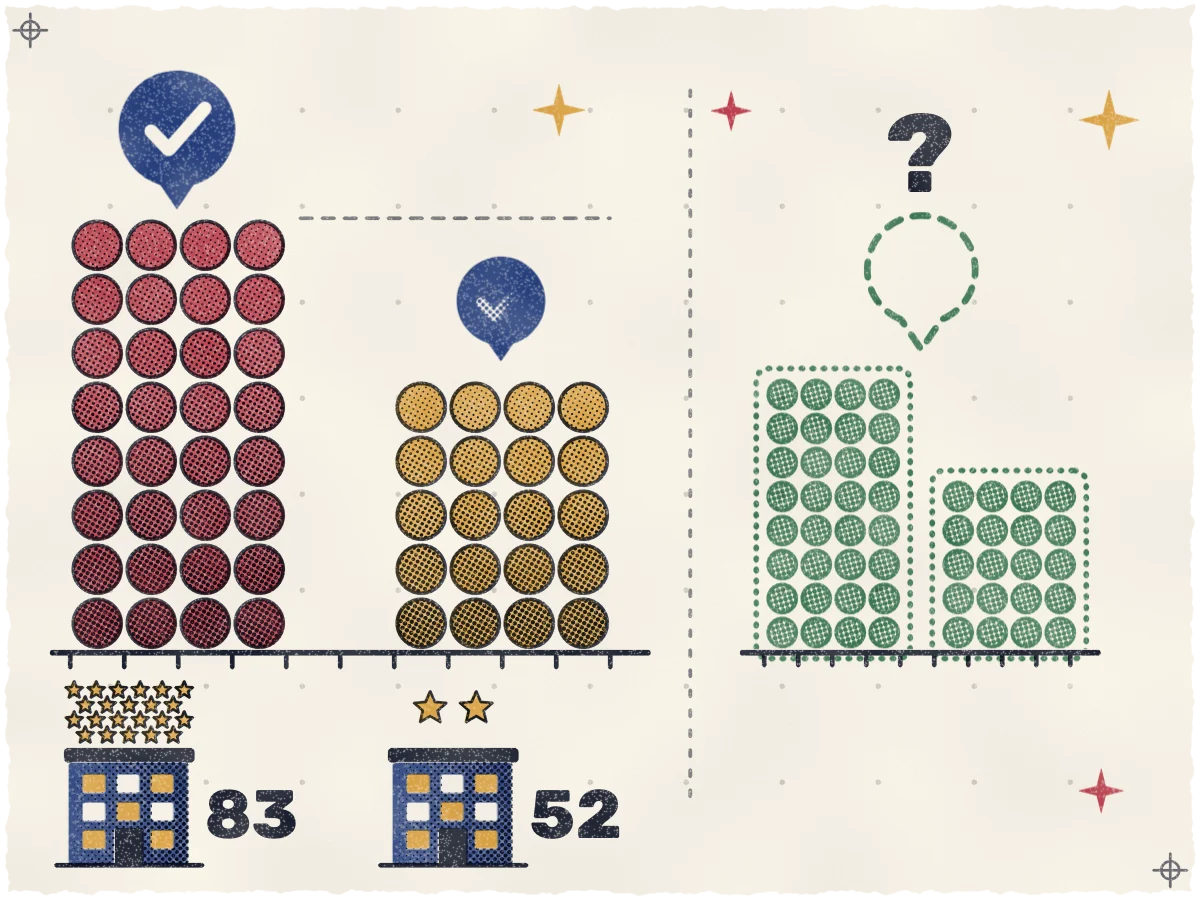
One more pattern bears on reviews. Local Falcon searched for 998 US hotels and found ChatGPT named 83.8% of those with 2,500 or more Google reviews, against 52.1% of those with fewer than 50. Only 34 hotels had 2,500 or more, though. The same company's study of 10,000 US restaurants in Google's AI Overviews found a smaller gap: restaurants with more than 1,000 reviews were left out 70.9% of the time, against 86.8% for those with fewer than 50, and the rate barely changed above 200 reviews.
Read all of this as correlation. These studies count what AI answers named or cited. They don't show that changing a website or profile changed an answer, and their authors sell tracking tools.
What nobody can say yet
The biggest open question is where ChatGPT gets its place data. Two suppliers say so publicly. In July 2026, Axios reported that Yelp licenses reviews, photos and business details to OpenAI under a non-exclusive deal. Foursquare's own site lists OpenAI among the apps its places data powers, without saying what for. Neither company says which countries this covers or how much of an answer it shapes, and OpenAI publishes no list of its local-data providers.
Other claims circulate. Some vendor posts say Bing Places feeds ChatGPT, resting on blog posts that show no method. Others say Foursquare supplies 60 to 70 percent of ChatGPT's local results. That figure came from a 2025 test of 50 prompts in five Spanish cities that counted only the first business named. A US test of 2,880 prompts in August 2026 found ChatGPT almost never cited Foursquare, though that doesn't rule out Foursquare data behind the scenes. We found nothing from OpenAI that confirms or rules out either.
The best public clue is one small pilot published in October 2026: 50 fresh ChatGPT chats, mostly German prompts about Munich. In the few records the authors checked closely, four pharmacies and eight other businesses, ratings and review counts matched Google Maps, and the place IDs were in a Google-compatible format. One hotel showed up under two labels, one of them Tripadvisor. The authors say they cannot identify the supplier. That fits a Google-like source without proving one, and 50 chats in Munich is thin evidence for Seoul.
We also found no company documentation of how Grok or Siri pick places for an open-ended question. If someone tells you exactly how they work, ask for the source.
The Korea gap
Every study we found used data from outside Korea, and you can check each one. BrightLocal's Local AI Visibility Study, from September 2026, ran localized prompts for 1,342 business locations. The study does not name a country, but its examples name places like Brooklyn and Manhattan. Local Falcon's Hotel AI Visibility Index, from the same month, covers 998 US hotels. Its Restaurant AI Visibility Index, from June 2026, covers 10,000 US restaurants. The Munich pilot used mostly German prompts. We found no published study of Seoul businesses, or of what a visitor in Korea gets when she asks in English.
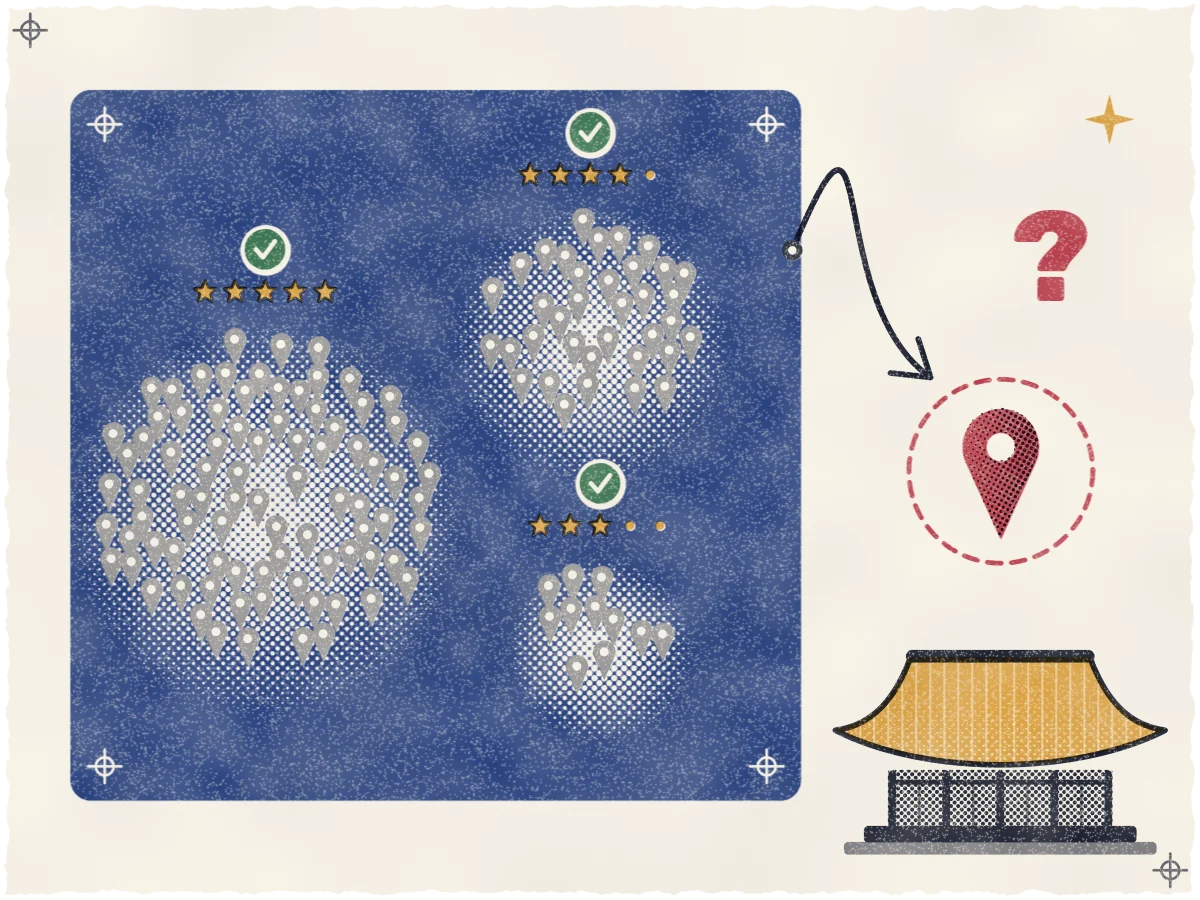
Seoul differs in ways that could change the answers. Locals get around with Naver Map and Kakao Map, which our guide to whether Google Maps works in Korea compares with Google. Korea conditionally approved export of Google's high-precision map data on February 27, 2026, and Google says it plans full Maps features here, but turn-by-turn navigation has not launched yet. Whether AI assistants have thinner data on Seoul, or lean on sources the US studies never saw, nobody has tested.
So we test it ourselves. Our AI tracking, part of what we do to help you be found, asks questions the way visitors do, in English, from spots around a business, and records who gets named and which sites get cited. We have no Seoul results to publish yet. Until we do, treat every US finding here as a lead to check, not a rule.
How many people ask AI
A March 2026 BrightLocal report, drawn from its Local Consumer Review Survey of 1,002 US adults, found that 45% use AI tools for local business recommendations, up from 6% the year before. That is one survey, and a jump that size shows a direction, not a count. We found no such number for visitors to Korea.
Your own customers give a better answer. Ask foreign guests how they found you and keep a tally at the counter for a month. It beats any national average.
We checked these pages on October 13, 2026. Google and OpenAI change them without notice.
What helps that you control
None of these is a switch that puts you in an answer, and we can't promise any of them moves one. They matter because they are what the documented systems read and what the vendor studies keep finding. They also help visitors who never open an AI app.
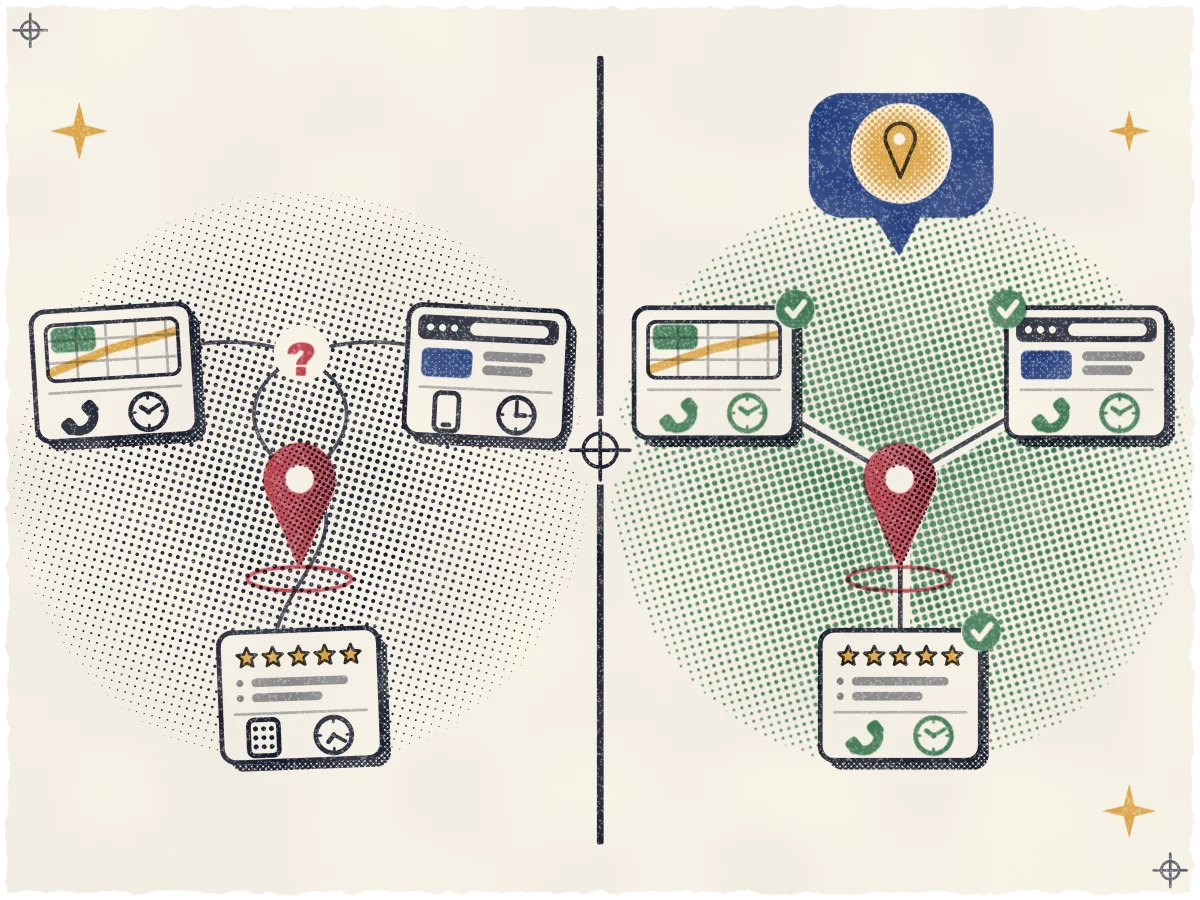
Keep your Google profile current. Google tells owners to, and Gemini reads from Google Maps. Hours, phone number (pick South Korea as the country and enter the number without +82), categories, photos and a clear English description should match what a visitor finds at your door, with holiday hours set before Seollal and Chuseok. Our Google Business Profile setup guide walks through the rest.
Put an English page on your website for each thing you sell. Say what it is, who it is for, the price range, and where you are, with the neighborhood and your road-name address. Write "hanbok rental near Gyeongbokgung Station," not just "our shop." A page like that gives a search tool something plain to read and quote. Our guide to an English website for your Korean business shows how.
Collect recent reviews and reply to them. Review volume went along with being named in the hotel study, and visitors read reviews either way. See our guide to Google reviews from foreign visitors for how to ask well and stay inside Google's rules.
Make your name, address and phone number match everywhere you appear, and get named on the "best of" lists and travel guides that cover your neighborhood. Mismatched facts can hurt, because a tool that finds two phone numbers has to guess which is right. The listings guide shows how to find which sites matter for your visitors in Seoul.
Say you run that Hongdae guesthouse. The 11 p.m. question is about food, not beds, so a plain page titled "Late-night food near our Hongdae guesthouse," with five named places, walking minutes from your door, opening hours and what to say at the counter in Korean, is something a search tool could quote. It also helps your guests. It costs an afternoon. It's a bet, not a promise, but a bet on something a real visitor needs.
Don't block search crawlers. Some website builders and security settings block unknown bots without telling you. Ask whoever runs your site to confirm that Googlebot and OAI-SearchBot can read your pages, using the robots.txt check in our English website guide. OpenAI says sites that block OAI-SearchBot are not shown in ChatGPT search answers, though they can still appear as plain navigational links.
How to check it yourself
Write five questions a visitor would ask, in English, such as "late-night Korean BBQ near Hongdae" or "hanbok rental near Gyeongbokgung." Ask each in ChatGPT, Gemini and Google's AI Mode, in a fresh chat, on several different days, and log the businesses named and the sites cited. Don't ask about your business by name; that tells you nothing about whether strangers find you. One screenshot proves nothing, since the next run may differ. A pattern across many runs is worth acting on. Our tracking guide explains what a fair test looks like, and our GEO guide lists what to ask anyone who offers to run it for you.
What not to buy
Don't buy a promise of an unpaid mention. Google and OpenAI both sell ads in or beside AI answers, labeled as ads, which is not the same as being named in the answer. Google runs ads inside AI Overviews only in English in a dozen countries, and Korea isn't one. OpenAI began a ChatGPT ad pilot in Korea on June 19, 2026, with ads kept apart from the answer. A seller who guarantees an unpaid ChatGPT mention is promising something no one outside the company controls.
Watch for four signs: a guaranteed mention or rank, a monthly fee for an llms.txt file or special markup that Google says you can skip, reviews bought or traded for your listing, and a report built on one screenshot. Our guide to GEO, llms.txt and AI SEO shows how to question any such pitch.
See where you stand today
Start with what you can see. Our free visibility map shows where your business ranks on Google Maps across your neighborhood today, with no contract. It's a starting point, and it promises no ranking, on Google Maps or in any AI answer. It shows you where to look first.
Sources
- OpenAI Help Center: Searching the web with ChatGPT
- Google Search Central: AI features and your website
- Google Search Central: Optimizing your website for generative AI features on Google Search
- TechCrunch: Google's AI Mode adds 5 new languages, including Hindi, Japanese and Korean (8 Sep 2025)
- OpenAI Help Center: ChatGPT search for Enterprise and Edu
- OpenAI: Overview of OpenAI crawlers (OAI-SearchBot and GPTBot)
- Gemini Apps Help: Find places & get directions in Gemini Apps
- Google AI for Developers: Grounding with Google Maps in the Gemini API
- Local Falcon: The Hotel AI Visibility Index (17 Sep 2026)
- Axios: Yelp partners with ChatGPT to surface reviews (23 Jul 2026)
- BrightLocal: Local AI Visibility Study (16 Sep 2026)
- Local Falcon: The Restaurant AI Visibility Index (12 Jun 2026)
- TechCrunch: South Korea opens the door to let Google Maps operate fully (27 Feb 2026)
- 9to5Google: Google Maps is finally going to bring turn-by-turn navigation to Korea (27 Aug 2026)
- BrightLocal: Local Consumer Review Survey 2026, AI trust (10 Mar 2026)
- Google Business Profile Help: Add your phone number
- Google Ads Help: About ads and AI Overviews
- Asiae: OpenAI launches ChatGPT advertising service in Korea (19 Jun 2026)
- SCAILE: How ChatGPT surfaces local businesses (9 Oct 2026)
- Foursquare: Business listings
- Steady Demand: ChatGPT's local results aren't coming from Foursquare (21 Aug 2026)