How Foreign Visitors Find and Choose Businesses in Korea
Many visitors choose where to go on Google, in reviews and, for some, in AI answers, then switch to Naver Map to find the door. Here is where that choice gets made, and what to fix first.

The moment a visitor chooses
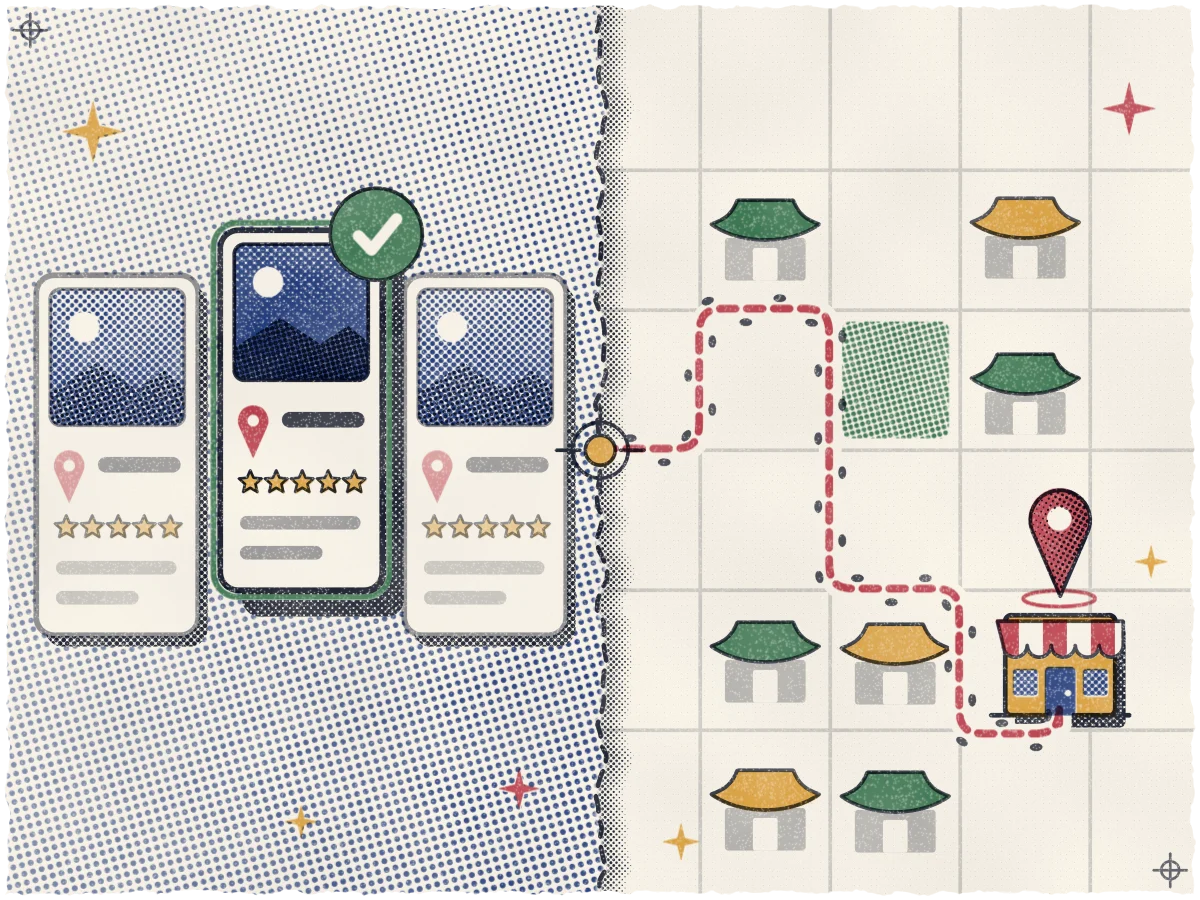
Picture an everyday scenario. It is 10 p.m. in a hotel room near Myeongdong. A traveler from Toronto has three Korean BBQ places open on her phone. She reads no Korean. She looks at the star ratings, scrolls the newest reviews, checks whether the owner replied, hunts for an English menu, and asks a chat app which one takes groups of four. Two minutes later she picks one. The other two never learn they were in the running.
In a study for the culture ministry, nearly every visitor used global apps such as Google before the trip, and most used Naver Map for routes once here. So much of the choice gets made on your Google listing, your reviews, your English website and, for some visitors, AI answers, while Naver keeps doing its job for your Korean customers. If you want foreign customers, start with your Google listing and reviews, then your English page, then check what AI assistants say about your street.
How many visitors come, and who they are
The Bank of Korea reported that Korea received 18.94 million international visitors in 2025. That is above the 2019 high of 17.5 million. They stayed 6.5 days on average and spent US$177.8 a day each. The OECD's Tourism Trends and Policies 2026 gives the same arrivals count, up 15.7% on 2024. This year is bigger: 15.05 million arrived from January through August, up 21.6% on the same months of 2025, according to the Ministry of Culture, Sports and Tourism and the Korea Tourism Organization.
| Figure | Number | From |
|---|---|---|
| Visitors in 2025 | 18.94 million, up 15.7% | OECD; Bank of Korea |
| Average stay, 2025 | 6.5 days | Bank of Korea |
| Spend per visitor per day, 2025 | US$177.8 | Bank of Korea |
| Visitors, January to August 2026 | 15.05 million, up 21.6% | Ministry of Culture, Sports and Tourism |
| Top markets, January to August 2026 | China 4.82 million, Japan 2.70 million, Taiwan 1.66 million, United States about 1.08 million | Ministry of Culture, Sports and Tourism; Seoul Economic Daily |
We checked these figures on October 12, 2026. The next update, the September arrivals release, should come in late October if the ministry keeps its usual timing.
China, Japan and Taiwan are the three biggest markets, and together they were roughly six in ten of this year's arrivals (our math on the ministry's counts). The United States comes next, at about 7%.
So English reaches a meaningful minority, not everyone. It covers American visitors and many travelers from elsewhere who use English as a shared language. It does not cover a tour group from Shanghai or a couple from Osaka who search in their own language. Ask your staff which countries your foreign customers come from. That answer beats any national average, and it tells you how much English can do for you.
Is it worth the effort for your shop?
It depends on where you are and what you sell. A hanbok rental near Gyeongbokgung, a photo studio in Seongsu, a guesthouse in Itaewon or a BBQ place two streets from Myeongdong sits where visitors already walk. For them, foreign customers can be a large share of the day's trade, and the listing is the front door. A gimbap shop in a residential corner of Nowon may see a handful of visitors a year. For that shop, a correct Google listing may be all it needs.
The first steps cost time, not money, and you can stop after any of them. Do the checklist at the end of this guide first, then decide how much more your own numbers justify.
Global apps before the trip, Korean apps on the street
A study for the culture ministry and the tourism organization, with fieldwork from October to December 2023, asked visitors which apps they used. In that study, most visitors used Naver Map for routes, but a third already used Google Maps. Visitors do not avoid Korean apps. They choose where to go with one set of tools and find the door with another, partly because Korean apps give precise transit times, the study found, and Google Maps here still had no turn-by-turn navigation as of Oct. 12, 2026. Our guide to Google Maps in Korea covers what it can and can't do here today.
What a visitor checks before choosing you
Visitors tend to check five places, and you can look at each one on your own phone today.
Your Google listing
For many visitors this is the first thing they see: your photos, English name, hours, category and phone number. In your Google profile, choose South Korea as the country and enter the number without +82. On your website and other listings, write it in international form, such as +82 2 followed by your number without the leading 0. A closing time that is wrong by an hour, or a missing note for Seollal or Chuseok, sends a traveler to a dark shop. Our guide to setting up your Google Business Profile walks through the fields in Korea's terms: Hangul and English names, road-name addresses and verification.
Your reviews and your replies
A visitor reads your newest reviews, then looks at how you answered the bad ones. A calm, specific reply in plain English tells a stranger that someone is running the place. A bad review with no reply, or a long defensive one, tells them the opposite. Never pay for reviews or reward them with discounts or free items. Google's rules forbid both, and it removes reviews it finds were bought. Our guide to Google reviews from foreign visitors covers how to ask, how to reply and what the rules allow.
Apple Maps
Maps comes on every iPhone, so many visitors meet your place there without searching for it. Apple's business pages list no way for Korean owners to claim or edit a place card, so what you can do there is limited to keeping your details consistent and reporting errors. Our guide to what you can control on Apple Maps in Korea sorts out what is and isn't possible.
AI assistants
Some visitors skip the search and ask ChatGPT, Gemini or Google's AI answers a plain question: where should we eat near Hongdae, and who has English-speaking staff? The answer names a few places. You can't pay to be named in the answer itself, though ChatGPT now shows labeled ads below some answers in Korea. These tools draw on listings, reviews and pages they can read, which is why the other four items here matter to them too. Our guide to how AI assistants choose local businesses explains what we know and what we don't. Treat any answer as a snapshot. Ask the same question twice and you may get two lists.
Your own English website
Google and AI assistants read your website. A Korean-only Naver blog or an Instagram page tells them little about who you serve in English. Say you run a hanbok rental near Gyeongbokgung. One clear English page with your prices, your address, how to walk there from Gyeongbokgung Station, your hours and a booking link does more than a long page nobody can read. Our guide to an English website Google and AI assistants can read shows what to put on it.
If you would rather hand this to someone, it is the work we do under Be found and Be chosen: profile, replies, a check of your website's titles and structured data, and the listings that feed AI answers.
How Google picks who shows up
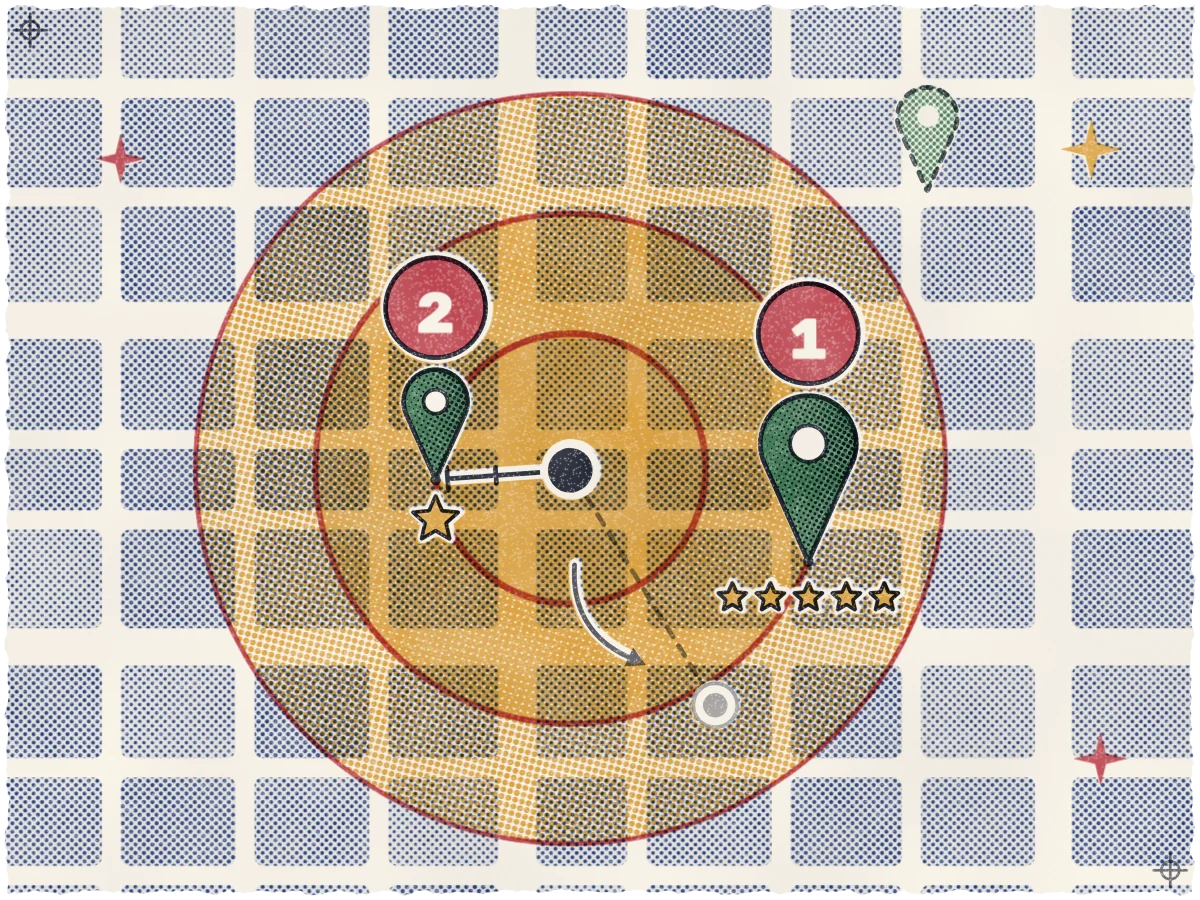
Google says local results rest mainly on three things: relevance, or how well your listing matches the search; distance, or how far you are from the person searching; and prominence, or how well known you are, which includes your review count and ratings. It also says there is no way to request or pay for a better local ranking. In a dense city that has a practical meaning. Say you search "korean bbq" outside Myeongdong Station and a place ranks second. Two blocks away it may not appear at all. Anyone who promises you the top spot is promising what neither of you controls. Why your Maps rank changes every few blocks covers ranking in depth.
Where Naver fits
Keep Naver Place current, and do it yourself. Your Korean customers still look you up there, and visitors check Naver Map on the street. Naver is courting them too. It says users of its Map app in foreign languages rose 16.4% in April 2026 compared with September 2025, which is Naver's own figure. This summer it ran the BE LOCAL campaign with the tourism organization and Busan, and it lets foreign users verify with a passport to book, order and pay in the app.
We do not manage Naver listings, and we do not suggest you drop Naver for Google. The two jobs sit side by side: Naver for the street and your regulars, Google and the rest for the choice made before the visitor leaves the hotel.
Levers outside search
Search is one lever. These others are outside our services, and they decide whether a visitor you win is a visitor you keep.
Advertise only the English you can deliver
An English menu sets an expectation of English service. A guest who sees "Pork belly, 200 g" and then meets a server with no English and no plan gets annoyed. Match the promise to the staff. If nobody speaks English, a translated menu with photos, QR code ordering or an English tablet menu can do the talking, and a phone translation app at the counter covers the rest. A short line on the door or your listing, such as "English menu, order by QR code," says exactly what is on offer.
Check that visitors can pay and book
In July 2026 the Korea Herald reported that Naver SmartPlace had a setting letting owners decline reservations and purchases made with overseas-issued cards, and that its instructions described switching it off as declining bookings from foreigners. After criticism, Naver said it was reviewing a rename to "global reservation/booking setting." It said overseas cards carry a 3.85% processing fee, and the report adds that foreign card issuers' chargeback rules can hit merchants when a card turns out to be stolen or the payment fraudulent. The fee is real. So is the lost customer, who simply picks the next tab. Open your own booking and payment settings, read what each switch does and decide on purpose.
Public support
The culture ministry and the Korea Tourism Organization ran roadshows in Busan, Jeonju and Seoul in April and May 2026, with an overview of the organization's inbound marketing support and one-on-one consultations with tourism specialists, open to businesses in medical services, wellness, beauty and food and beverage, among others. Those events are over. The organization's industry portal, touraz.kr, is in Korean. When we checked on October 12 it still had an inbound marketing section and a page for booking a business consultation. Check it before you plan around any support.
Your first week
You can do all five of these without hiring anyone.

- Claim or check your Google profile. Search your business name on Google Maps on your phone. If you see "Claim this business" or "Own this business?", nobody manages it yet, so claim it. If you see neither and can't edit it, someone else may manage it, perhaps a former employee or an agency you left. Request access at business.google.com/add.
- Fix name, address, phone and hours. In your Google profile, choose South Korea as the country and enter the number without +82; on your website and other listings, write it as +82 with the leading 0 dropped. Add Seollal and Chuseok closures now, not the week before.
- Read your last 20 reviews. Note what repeats: the wait, the English menu, the price. Reply to any that are still unanswered.
- Check your English web page on your phone. If you have none, write down what it would need: menu, address, hours, booking link.
- Ask ChatGPT about your area in English, for example "Where should a group of four eat Korean BBQ near Hongdae, with an English menu?" Note who it names and whether you appear. Ask a second time, and write down the differences (why answers change and how to log them).
Rankings and AI answers jump around from day to day, so judge the trend over months, not days. Watch the numbers your Google profile already shows, such as calls, website clicks and direction requests. Download the report each month and keep it, so you can compare the same month a year apart. Chuseok and Seollal swing the totals, and Google doesn't say how long it keeps the history.
See where you stand today
If you want your starting point first, ask for a free visibility map. Tell us your business and the search you want to win. We show where you appear today across your neighborhood, and where the biggest openings are. It shows today's picture and promises no rank. How it works explains what happens after that, and you do not have to continue.
Sources
- The Korea Times: Foreign spending accounts for 1.17% of Korean GDP in 2025 (Bank of Korea report), August 5, 2026
- Edaily: OECD Tourism Trends and Policies 2026 on Korea, July 2026
- Ministry of Culture, Sports and Tourism: Inbound arrivals surpass 15 million through August 2026, September 28, 2026
- Seoul Economic Daily: Foreign visitors to Korea top 15 million in eight months, September 29, 2026
- The Korea Times: Visitors to Korea to hit record 18.7 million, outpacing pre-pandemic high, December 23, 2025
- Korea.net: Foreign tourists prefer domestic apps like Naver Map for visits (KTO and MCST travel app study, March 2024)
- The Korea Herald: Google confirms plans for turn-by-turn navigation in Korea, August 25, 2026
- Google Maps contribution policy: Fake engagement
- Google Business Profile Help: Tips to improve your local ranking on Google
- Edaily: Naver Map foreign-language users and the BE LOCAL campaign, June 2026
- The Korea Herald via Asia News Network: Naver reviews renaming SmartPlace setting on overseas cards, July 17, 2026
- The Korea Times: Government launches 3-city roadshow to bolster tourism marketing, April 14, 2026
- Touraz: Korea Tourism Organization tourism industry portal (Korean)