How Google Maps Ranks Businesses, and Why Your Rank Changes Every Block
You searched from your own counter and saw yourself near the top, but your visitors search from hotels, stations and landmarks, where you may not show at all. Here is why, and how to see your real position.
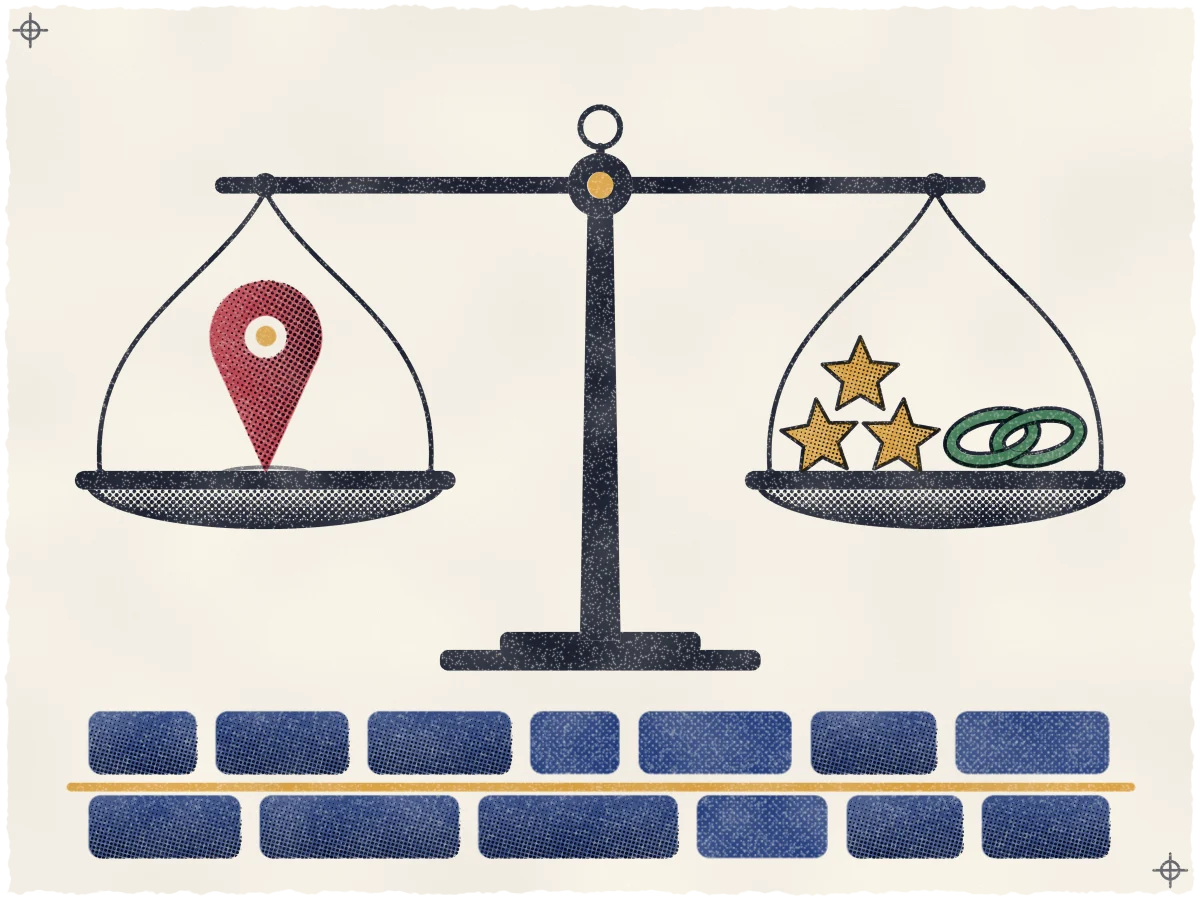
There is no single Google Maps rank for your business. The result depends on where the searcher stands, so a shop that is second on one corner can be missing two blocks later. If you checked from behind your own counter, you saw the best view you will ever get. Your visitors search from somewhere else.
An illustration: one café, three corners
Say you run a small café near Myeongdong Station. The ranks below are made up to show the pattern. They are not data from a client or from a real shop.
| Where the visitor searches "cafe near me" | What changed | Your rank |
|---|---|---|
| Outside the station exit | You are close and well matched | 2 |
| A hotel lobby one block away | Two cafés now sit nearer | 6 |
| A hotel lobby two blocks away | A dozen cafés sit nearer | Not shown |
Nothing about your café changed between those lines. The same profile, with the same reviews and hours, ranked differently because the searcher moved. Visitors search from a hotel bed, a subway platform or the line outside a landmark, and they pick from the few places Google shows them there. The words they type matter too: "cafe near me" and "dessert cafe myeongdong" are different searches with different lists.
Google's three ranking factors, in plain words
Google says local results rest mainly on three things, which it lays out on its page about improving your local ranking.
Relevance is how well your profile matches the search. A café that lists coffee, brunch and desserts matches "cafe" better than a profile with a vague category and no description. Google asks for complete, detailed information so it can match you to the right searches, which is why a complete Google Business Profile comes first.
Distance is how far you are from the person searching. If they have not shared a location, Google uses what it knows about where they are. You cannot change this factor, and it is the reason your rank moves as people move.
Prominence is how well known you are. Google says this draws on how many websites link to your business and how many reviews you have, and that more reviews and positive ratings can help. Our guide to how reviews feed prominence covers the review side for foreign visitors.
Google states there is no way to request or pay for a better local ranking. Keep that sentence in mind when someone offers to sell you one.
What local search experts rate highest
Google does not publish its weights. The closest public view is a survey of local search practitioners. Whitespark published its Local Search Ranking Factors 2026 on November 6, 2025, after 47 experts scored 187 factors. The report says none of them has special access to Google's algorithm. This is expert opinion drawn from their testing, not Google data.
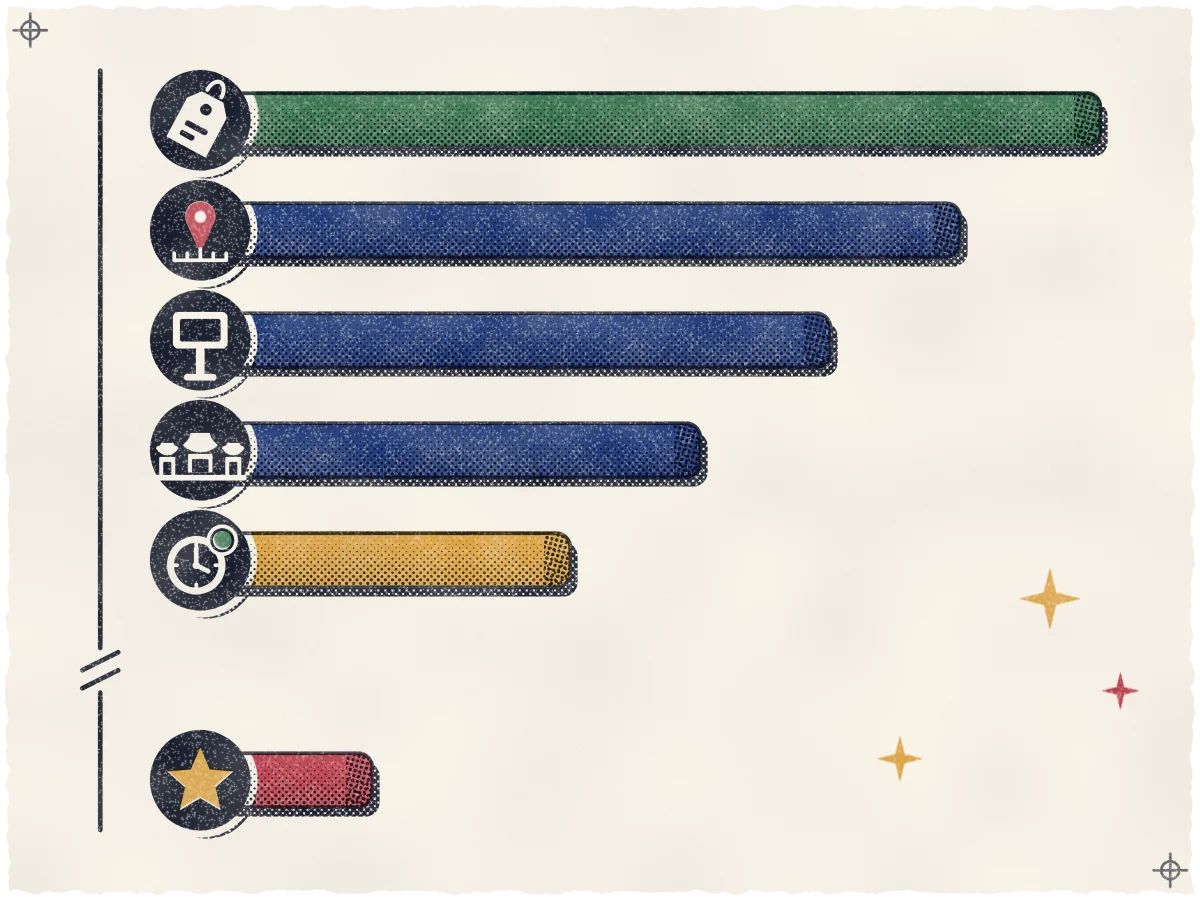
For the local pack and Maps, the experts put these five first:
- The primary category on your profile.
- How close your address is to the searcher.
- Keywords in the business name.
- A physical address in the city being searched.
- Being open at the time of the search.
A high Google rating came sixth and the number of reviews with text came ninth. That does not mean reviews do not matter, since Google itself names them under prominence. It means the experts think category, location and hours count for more than one more star.
Two details are easy for a Seoul owner to miss. If the experts are right about hours, a profile that shows you closed on a Chuseok morning when you are open is losing searches as well as visitors, so keep holiday hours accurate for Seollal, Chuseok and every other day you change. And the survey ranks a correctly placed map pin tenth: your road-name address and your pin should both point to the door a visitor walks through, not the back of the building.
The business name trap
The third item looks like a gift: put "Korean BBQ Myeongdong" in your name and climb. Do not. Google's guidelines for business profiles list marketing taglines, service or product information and location information as things a name must not include, and say the extra words could lead to your profile being suspended. A suspension, even a short one, can cost you more than any keyword gains. Read why keywords in your business name are a risk before you edit anything.
Where foreign visitors actually stand
Because distance counts, the spots that matter are the ones where foreign visitors gather. A Seoul AI Foundation report on 2025 data, built from SK Telecom foot-traffic figures and reported by The Korea Times in July 2026, puts numbers on it. Myeongdong averaged 100,910 foreigners in its foot traffic a day. Foreigners made up 47.1% of foot traffic in Myeongdong and 55.7% at N Seoul Tower.
In places like these, about half the crowd is foreign, and almost none of them search from your doorway. In a dense district many similar businesses share a few streets, so a short walk changes which ones sit nearest. Our guide to how foreign visitors find businesses in Korea covers what they do once the map is open.
A rank check you can do this week
Before any tool, walk it yourself. Pick the search a visitor would type, such as "korean bbq near me" or "hanbok rental gyeongbokgung", and set your phone to English. Run it from your counter, then the nearest subway exit, then the closest hotel lobby, then a landmark where visitors queue. Write down where you appear each time, or that you do not.
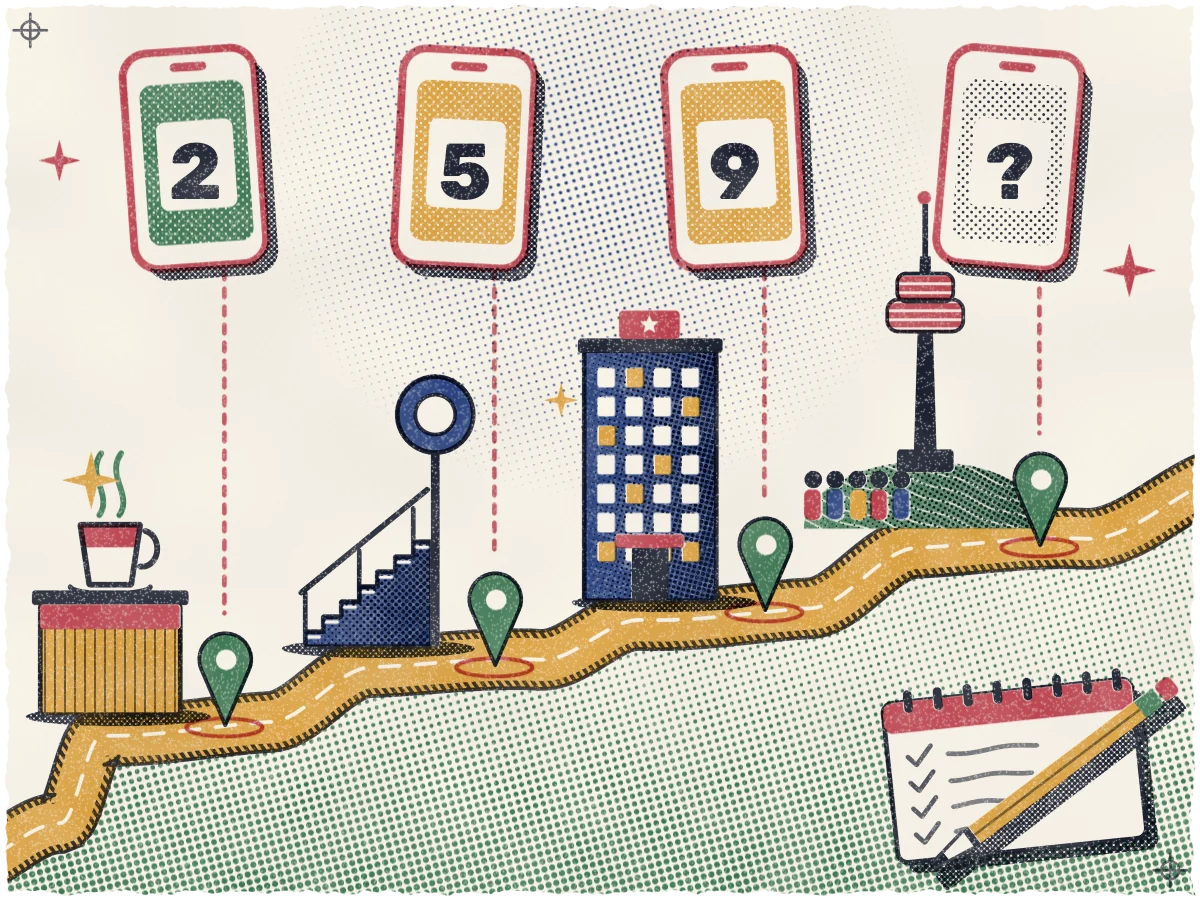
Four readings tell you more than one, but they are still four points. They show the problem. They do not size it.
How to read a geo-grid rank map
A geo-grid rank tracker answers the question one search cannot. It lays a grid of points over your neighborhood, checks your rank as if a searcher stood at each point, and draws a circle at every spot with the rank inside. Most tools color the circles, often green for a top rank shading to red for a low one, but the colors and the mark for "not shown" differ from tool to tool, so check the legend.
Read it in three steps:
- Find your own door. That is the number you saw from the shop, and the one that misled you.
- Look at the spread. A strong center that drops off within a ring or two means you only win when people are very close.
- Check the spots that matter. Is the circle at the station exit or the hotel cluster near the top, or does it show you low or not at all?
The summary number we use is your share of top-3 spots. If 12 of 49 points place you first, second or third, your share is about 24%. It gives you one number to watch as the work takes effect. The example maps on our homepage show how a visibility map is laid out; they are examples, not results from a client.
Which searches and which area to map
A map is only as useful as the search behind it. Map the words a visitor types in English, such as "korean bbq near me", "hanbok rental" or "nail salon hongdae", not your own name, which only people who already know you will type. Map each important search separately, because a strong map for "cafe" says nothing about "brunch".
Then size the grid to how far your visitors walk. In Myeongdong, Insadong or around Hongik University Station, points a block or two apart catch the changes that matter. A grid spread over several kilometers hides them, because each circle covers a whole neighborhood. Make sure at least one point lands on the station exits, hotel clusters and landmarks your visitors start from.
AI answers shift by location too, and the same grid idea applies when you measure them.
What you can change, and what you can't
You can change the things on your side of the screen:
- Your primary category, plus any secondary categories that are true.
- A complete profile: description, services, attributes, photos, and a correct address and pin.
- Your hours, including Seollal, Chuseok and any other day you close.
- Your reviews, through an honest, low-key ask and a reply to each one.
- Accurate listings and earned mentions on other sites, such as travel guides and directories, plus a clear page on your own website.
You cannot change where your shop stands, where the searcher stands, who else opens on your street, or how Google's systems weigh each signal. Good work improves your odds and can widen the area where you show. It does not make you first everywhere.
Why a rank promise is a red flag
Google says rank cannot be bought. Yet listings on Kmong, a Korean freelance marketplace, sell Google Maps work with a full refund if an agreed target is missed, and say their methods cause no "abuse" or "low-quality" problems. Neither promise holds up. No outsider controls your ranking, so a refund tied to a goal is a bet on a number nobody outside Google sets. And no outsider can promise your profile stays safe, because suspensions come from Google's reading of its own guidelines, including the name stuffing described above.
Watch for a set price with an outcome or a safety promise attached. Ask any provider two questions: what result do you promise, and from where is it measured? And what exactly will you change on my profile? An honest answer to the first is that no one can promise a position. An honest answer to the second is a list of tasks. We hold ourselves to the same line: we do not guarantee a position, we show where you stand and keep working on what you control, as our answers to common questions say.
See where you stand today
Before you change anything, find out what your visitors see. Our free visibility map checks your rank from points around your door and shows where you appear and where you vanish. There is no ranking promise and no contract. Send your business name, address and the search you care about through the free visibility map form.
Sources
- Google Business Profile Help: Improve your local ranking on Google
- Whitespark: Local Search Ranking Factors 2026 (published November 6, 2025)
- Google Business Profile Help: Guidelines for representing your business on Google
- The Korea Times: Foreign tourists increasingly flock to Seoul's markets, hiking spots (July 22, 2026)
- Kmong: Google Maps optimization listing with a refund-if-missed target